
< img height="1" width="1" style="display:none" src="https://www.facebook.com/tr?id=774823132380368&ev=PageView&noscript=1" />
Info Center

Overcome Cu-Al Busbar Challenges: Ultrasonic Welding vs Traditional Methods

铜铝连接瓶颈突破 · 固态超声焊接技术 | 广州金合能超声

Overcoming the Copper-Aluminum Bottleneck in Busbar Manufacturing

Advanced solid-state joining technology for high-performance EV battery modules and energy storage systems.

Technical Summary: Guangzhou Jinhe Neng Ultrasound's solid-state ultrasonic welding technology can join copper and aluminum without melting, avoiding the formation of brittle intermetallic compounds and oxide inclusions - the fatal weaknesses of traditional fusion welding. The final joint achieves low resistance and high mechanical strength, suitable for EV battery packs, power electronics, and high-voltage wiring harnesses, with minimal heat impact. Performance highlights: contact resistance < 0.1 mΩ, base material tearing in destructive testing, cycle time of only 0.5-1.5 seconds, and compatibility with automated production lines. The application engineer team provides free feasibility studies, cross-sectional analysis, and resistance mapping verification.

The Science of Solid-State Joining

Traditional fusion joining methods (Laser, Resistance, Soldering) rely on high-intensity thermal energy to melt materials. When applied to Copper (Cu) and Aluminum (Al), this melting triggers the formation of Intermetallic Compounds (IMCs)—hard, brittle layers that reduce mechanical life and electrical reliability.

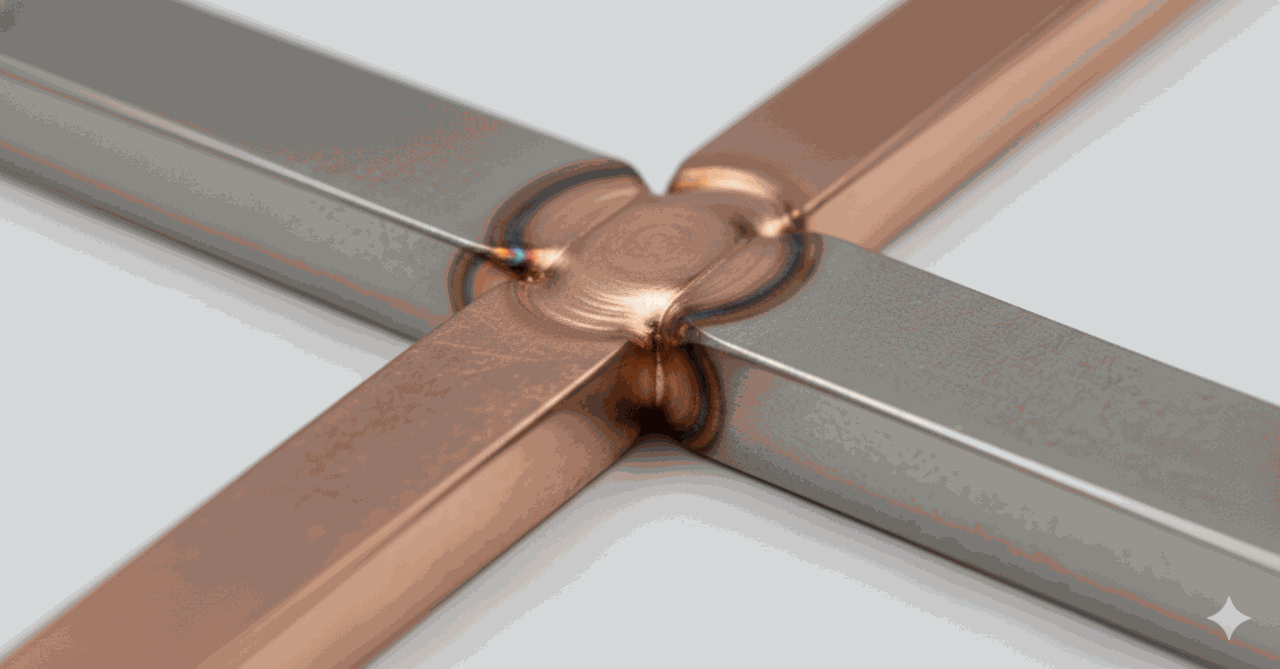
Our ultrasonic process creates a metallurgical bond without melting. High-frequency friction disrupts surface oxides and initiates lattice diffusion at the atomic level, eliminating IMC growth and achieving pure metal-to-metal contact with minimal thermal impact.
           Ultrasonic solid-state joining diagram

Why Traditional Processes Often Fail

Bimetallic busbars reduce weight and cost, but they introduce fatal engineering hurdles when heat is applied via conventional methods:

  • Intermetallic Fragility: The delta in melting points leads to uncontrollable eutectic reactions, making joints prone to cracking under vehicle vibrations and thermal cycling.

  • Insulating Oxides: Aluminum's oxide layer is a persistent insulator. Fusion methods trap these oxides, leading to dangerous thermal runaway risks and high contact resistance.

  • Thermal Mismatch: Copper's high conductivity draws energy away, causing the aluminum side to warp or suffer burn-through during welding, resulting in inconsistent joint quality.

Critical Application Scenarios

Because our ultrasonic equipment is insensitive to melting point differences, it is the premier choice for:

  • EV Battery Packs: Welding multi-layer copper foils to thick aluminum busbars — perfect for pouch and prismatic cell interconnections.

  • Power Electronics: Connecting copper terminals to aluminum heat sinks without thermal damage to sensitive IGBTs or MOSFETs.

  • HV Wire Harnesses: Securely compacting and welding stranded copper wires to aluminum terminals for reliable high-voltage connections.

Ultrasonic Welding Performance Benchmarks

< 0.1 mΩ            Contact Resistance

Equivalent to base metal conductivity, minimizing heat generation and power loss — achieved with ultrasonic bonding.

100%            Base Metal Tear

During destructive testing, the aluminum base metal tears before the weld fails — consistent across ultrasonic Cu-Al joints.

0.5 - 1.5s            Cycle Time

Optimized for high-speed automated assembly with inline quality monitoring — typical of ultrasonic welding systems.

Performance data based on JHN ultrasonic metal welding system

Consult Our Application Engineers

Send us your busbar materials for a free feasibility study, cross-sectional analysis, and resistance mapping. Accelerate your EV and ESS projects with reliable Cu-Al joints.

               📞 Contact Us →            

Frequently Asked Questions

What is the copper–aluminum “bottleneck” in busbar manufacturing, and why do traditional fusion methods struggle?
Copper and aluminum are attractive for bimetallic busbars but are difficult to join with heat-based methods. Melting triggers brittle intermetallic compound (IMC) formation, aluminum’s oxide layer gets trapped and insulates the joint, and copper’s high conductivity causes uneven heating that can warp or burn through the aluminum—leading to weak, unreliable connections.
How does solid-state ultrasonic welding overcome these issues?
Ultrasonic welding creates a metallurgical bond without melting. High-frequency friction disrupts surface oxides and initiates lattice diffusion at the atomic level, avoiding IMC formation and oxide entrapment. The process delivers low-resistance, mechanically robust joints with minimal thermal impact, preserving material properties.
What performance benchmarks can I expect from this process?
The process achieves under 0.1 mΩ contact resistance (near base-metal conductivity), 100% base metal tear in destructive testing (the aluminum tears before the weld fails), and 0.5–1.5 second cycle times suitable for high-speed automated production — ensuring both quality and throughput.
Which applications benefit most from ultrasonic Cu–Al joining?
It is ideal for EV battery packs (e.g., welding multilayer copper foils to thick aluminum busbars), power electronics (copper terminals to aluminum heat sinks without harming sensitive components), and high-voltage wire harnesses (compacting and welding stranded copper wires to aluminum terminals).
What does “100% base metal tear” indicate about joint quality?
In destructive tests, the aluminum base metal fractures before the weld itself fails, indicating the joint is stronger than the surrounding aluminum and confirming high mechanical integrity — essential for vibration-heavy environments like electric vehicles.
⚙️ Guangzhou Jinheneng Ultrasonic Technology Co., Ltd. · Solid-State Welding Solutions for Copper-Aluminum Busbars
Contact
97danny@gmail.com